Difference Between Active Funds and Passive Funds: Which One to Choose
Active funds aim to beat the market, while passive funds track indexes at lower costs. Choose wisely.

Overview
Mutual funds in India can be classified into two broad categories based on the approach used by investors to achieve their goals: active and passive approaches are as given:
The active approach entails the use of a fund manager and a research team, who choose stocks with a view to earning alpha returns, which are above the index.
Actively managed funds offer professional expertise and flexibility. They allow for altering stock composition to prevent market downturns from affecting the fund. There are no assurances that active funds will perform well because of previous performance.
On the other hand, the passive approach entails tracking a chosen index, such as the Nifty 50, in an attempt to replicate its performance. Investors need to know the differences between the two approaches in order to make wise decisions based on their financial objectives and risk tolerance.
Active and passive management are the two primary philosophies used to manage investment portfolios. They represent the choice between human intuition and systematic automation.
The biggest advantage of passively managed funds is that there is transparency. Investors are aware of all the stocks that are held by the funds.
Investors are advised to stay updated with all the data related to funds. This paper is meant to present factual data. It strictly adheres to the guidelines provided by Indian regulators.
The Concept of Active Mutual Fund and its Investing Strategy
For active mutual funds is:
An active mutual fund focuses on outperforming a benchmark index by investing in stocks. The portfolio manager along with a team of financial analysts engages in detailed analysis to determine investments that can produce better results than the general market index.
Such funds require an active strategy, in which the portfolio manager makes regular purchases and sales of stocks based on market and individual stock performance.
Active mutual funds may be ideal for investors looking for alpha because they produce returns that exceed the index. It is worth noting that these types of funds involve "manager risk."
Due to the necessity of conducting detailed analysis and trading of stocks frequently, such funds usually incur higher expenses than their passive counterparts.Passive Investment Framework
Passive investment tries to replicate the performance of the selected benchmark index like Nifty 50 or Sensex rather than trying to beat the index return. In this approach, instead of picking particular stocks, the manager invests in those stocks present in the same proportion as the index.
This is usually achieved by using Index Funds or ETFs.
Minimizing tracking error is the main focus for any passive investment scheme. The tracking error is the variance of performance between the investment return and benchmark return. There will be very little stock selection activity and hence low cost associated with it.
Active Funds Vs Passive Mutual Funds
Active vs. passive funds can be summarized as a trade-off between the pursuit of "alpha" (market-beating returns) and the efficiency of "beta" (market-matching returns). Active funds try to outperform the market, while passive funds try to match the performance of the market.
The main characteristic of active management is high turnover, but in passive management, the portfolio is not changed frequently.
The differences between active funds and passive mutual funds are described below:
Feature | Active Mutual Funds | Passive Mutual Funds |
Objective | Outperform the benchmark index +1 | Match the benchmark index performance +2 |
Management | Professionally managed by a fund manager | Automated tracking of an index +1 |
Expense Ratio | Generally higher due to research costs +1 | Lower due to minimal intervention +1 |
Risk Profile | Includes market risk and manager risk +1 | Primarily market risk +1 |
Cost Structure and Expense Ratio Analysis
Expense ratios are one of the considerations used while analyzing active and passive investments. The cost associated with an active portfolio pays salaries to researchers as well as covers the costs of transactions and administration. Such costs may influence the final gains of the investor after a long period of time.
Passive portfolios do not require a lot of resources for their maintenance. Since they only mimic the index, there is no need for extensive analysis to be carried out.
Active vs. Passive Risk Assessment
There is always an element of risk involved in investments. In actively managed funds, investors rely on the competence of the fund manager. Passively managed funds rely on the general trend of the market. The business cycle tends to favor one type of investment over another.
Active funds outperform passive funds in volatile situations. Passively managed funds tend to outshine when the market is bullish without any interruptions. Investors are advised to consider their investment objectives prior to selecting the fund.
Active funds and passive funds are the actual investment vehicles. Active funds vs. passive funds have been repositioned in modern portfolios. There are various risks associated with all investments. In active management, the major risk involved is the failure of the strategy to beat the index. It is referred to as “active risk.”
In passive management, the risks associated with managers are eliminated since passive funds do not have any manager. However, passive funds are exposed to all market risks. For instance, if the index drops by 10%, the passive fund will also be affected adversely to a similar extent.
Asset Allocation and Diversification Approach
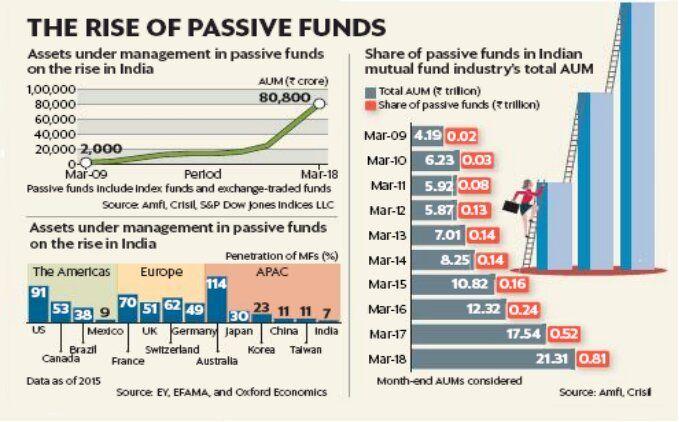
Asset allocation in the case of an actively managed fund is based on the conviction of the fund manager and depends on the goal set for the portfolio. This kind of approach allows for high concentration in particular stocks that may bring in substantial outperformance in case the stock picked up by the manager turns out to be the right choice.
A passive fund has a strict asset allocation policy where its portfolio should resemble the benchmark index. Thus, diversification is fully automatic. So, if the index comprises 50 stocks, the fund automatically includes all of them in its portfolio without any changes to their proportion.
Although this strategy allows the fund not to lose money due to bad asset allocation, it leaves the fund unable to get rid of deteriorating sectors.
The Concept of Information Asymmetry and Market Efficiency
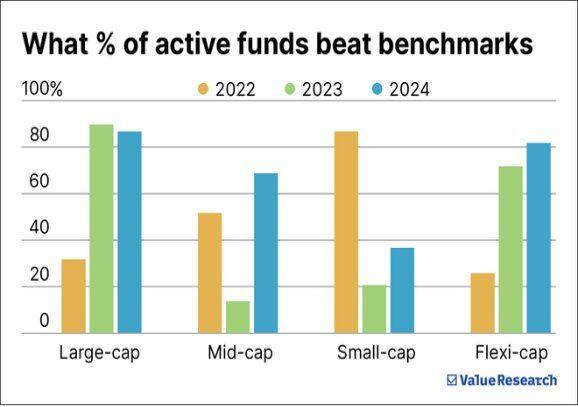
The decision whether to opt for active management or passive management depends upon the issue of market efficiency. Efficient markets, especially large-cap stocks, have abundant availability of information, making it impossible for active investors to constantly find "overvalued/undervalued" stocks that help beat the market. Thus, due to cost efficiency, passive investors have enjoyed greater popularity among large-cap segments.
On the other hand, inefficient markets, such as mid-cap stocks or small-cap stocks, may have higher levels of information asymmetry. In this case, thorough research and practical analysis performed by active investors may bring forth growth stocks that are not yet considered by the market at large.
Hence, an investor may choose active management in those particular cases where an expert’s contribution brings added value.
Performance Benchmarking and Tracking Error
Active mutual funds are gauged according to the fund's "alpha." When the Nifty 50 makes 12% and the active mutual fund makes 14%, the alpha becomes 2%. While it is true that there are many active mutual funds that have outperformed in the past, past performance does not guarantee future results.
Passive mutual funds are gauged through their "tracking error." The smaller the tracking error, the better is the fund's adherence to its benchmark. When there is growth of 10% in the index and 9.8% growth in the mutual fund, the gap of 0.2% represents the tracking error.
Tax Implications and Turnover Ratios
The internal trading activity that takes place in the fund, otherwise referred to as the turnover ratio, plays a crucial role in tax efficiency. The turnover ratio is usually higher in actively managed funds since the fund manager often engages in buying and selling activities in order to benefit from the prevailing market conditions.
The investor will only incur capital gains tax when they sell off their units in the fund, although internal activities might affect the fund's performance indirectly through an increased expense ratio.
Conversely, passive funds have very low turnover ratios. Passive managers buy or sell securities whenever there is a need to rebalance the benchmarked index used by the fund, typically occurring twice annually, or when there are high inflows or outflows in the fund. In general terms, a low turnover is usually more efficient than the active fund.
This knowledge is quite important in helping retail investors understand what goes on behind the scenes.
What Factors Should Be Taken Into Account When Making a Choice?
The investor’s level of risk and the purpose of investments matter. The individuals who trust the market efficiency should invest in passive mutual funds due to their convenience and affordability. Those who do not believe that the market operates efficiently would choose active funds.
The "core and satellite" principle of investment is also popular among investors. It presupposes that passive funds make up the core and serve as tools to earn money from general market performance, while active mutual funds are satellites used to obtain high returns from particular areas.
Evaluating Metrics to Select a Mutual Fund
Active funds vs. passive funds can be viewed as a choice between seeking "alpha" through professional expertise and capturing "beta" through market-wide growth. To compare and contrast an active mutual fund versus a passive mutual fund, investors need to rely on several metrics.
In the case of active mutual funds, two significant metrics that must be considered include "standard deviation" and "Sharpe ratio." Standard deviation is a measure of risk, while the Sharpe ratio is a measure of performance. The greater the Sharpe ratio, the more effective the active mutual fund manager is at managing risks and generating returns.
The only metric required to evaluate a passive mutual fund is the "tracking difference." This is the difference between the returns earned by the index and the passive mutual fund.
The tracking error measures the volatility in the tracking difference, while the tracking difference measures the lag. The tracking difference includes the expenses incurred and the portion of cash investments made.
Conclusion
Active and passive funds each play an important part in a portfolio. The former is designed to earn returns above those provided by the market due to their management skills. Meanwhile, the latter is an easy and cheap means to share in the market gains. It would be wise to assess your financial needs with the help of a financial adviser.
When forming a portfolio, one must take into account the effect of periodic costs, like an expense ratio, that can substantially affect net returns throughout many years.

Disclaimer: This content is intended for informational and educational purposes only and does not constitute investment advice, financial advice, tax advice, or a recommendation to buy, sell, or hold any security or financial product. Investments are subject to market risks, and past performance is not indicative of future results. Readers should conduct their own research and consult a qualified financial advisor before making investment decisions.
Frequently Asked Questions
Passive funds are generally better for beginners as they are low-cost, simple, and track market indexes.
No, active funds may outperform occasionally, but most fail to consistently beat the market over time.
Passive funds cost less because they simply track an index and require minimal management.
Yes, combining both can balance stability (passive) and growth potential (active).
It depends on your goals, risk tolerance, and preference for cost vs. potential higher returns.